Dead Limbs That Threaten Property and Safety
Tree Pruning for properties with dead, damaged, or diseased limbs requiring removal
Dead wood loses structural integrity as decay organisms break down cell walls, creating unpredictable failure points that drop limbs without warning during wind events or under the weight of snow and ice accumulation common in northern Minnesota winters. Tree pruning removes compromised wood before failure occurs, protecting people, vehicles, and structures positioned below the canopy. Whits End Tree Care provides pruning services focused on eliminating hazardous limbs while promoting healthier growth patterns in the remaining structure.
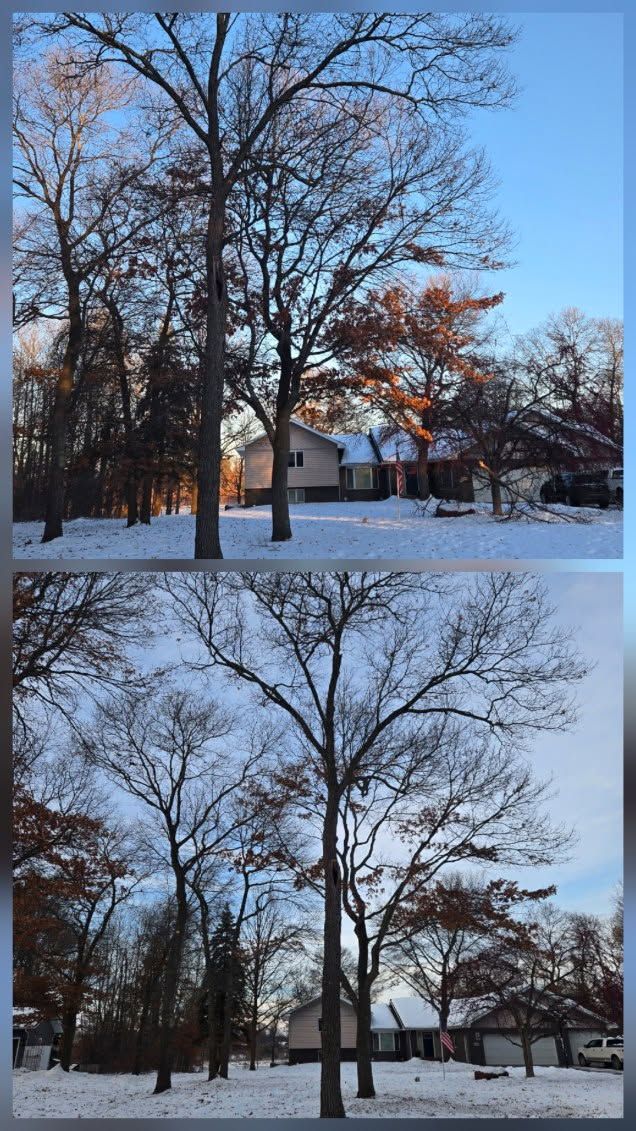
Pruning targets branches that show visible decay, cracks where limbs attach to the trunk, discolored bark indicating disease spread, or mechanical damage from previous storm events. Each cut is positioned to remove the compromised section while preserving healthy wood that continues supporting the tree's canopy and structural balance.
Request a professional tree evaluation to identify limbs that require removal before they fail.
How Pruning Protects Tree Health
Proper pruning involves cutting just outside the branch collar where the limb attaches to the trunk or parent branch, allowing the tree to form protective callus tissue that seals the wound and prevents decay organisms from entering healthy wood. Cuts that leave long stubs or remove the collar tissue itself compromise the tree's natural defense mechanisms and create entry points for infection. Diseased limbs are removed and disposed of off-site rather than chipped on the property to prevent pathogen spread to healthy trees.
After pruning, your property will have eliminated overhead hazards from dead limbs, improved tree structure with weight distributed more evenly across remaining branches, and reduced disease pressure that could spread to healthy sections of the canopy. The tree redirects energy from attempting to maintain failing limbs toward supporting healthy growth, often resulting in increased foliage density in areas that receive adequate sunlight.
Pruning differs from trimming in that it addresses wood that is already compromised rather than shaping healthy growth, and the work is often necessary regardless of season when hazardous dead limbs are identified. Preventative pruning performed regularly reduces the likelihood of large limb failures that require emergency response and create more significant wounds on the tree.
Answers to Frequent Pruning Questions
Property owners often need clarification about how pruning differs from other tree services and what results to expect after dead wood removal.
How can you tell if a limb is dead?
Dead branches lack foliage during the growing season, bark may be loose or missing, wood is brittle and breaks easily, and no green cambium layer appears when bark is scraped away.
Why remove dead branches if they're not actively falling?
Dead wood becomes increasingly brittle as decay progresses, and failure often occurs suddenly during weather events when ice load, wind force, or heavy snow accumulation exceeds the weakened wood's capacity.
What happens if diseased limbs are not pruned?
Disease organisms continue spreading into healthy wood, weakening additional sections of the tree and potentially reaching the trunk where infection becomes much more difficult to contain.
How much of a tree can be safely pruned at once?
Removing more than 25 percent of the canopy in a single season stresses the tree and reduces its ability to produce energy through photosynthesis, so severe pruning is often staged across multiple years.
Does Brainerd's climate affect when pruning should be done?
Pruning during active growth periods in spring can stress trees and attract insects to fresh wounds, while dormant season work in fall and winter minimizes disease transmission and allows wounds to begin sealing before spring growth begins.
Where does Whits End Tree Care offer these services?
Where does Whits End Tree Care offer these services? Whits End Tree Care operates in Crow Wing, Cass, Aitkin, Mille Lacs and Morrison counties. Some cities we operate in are Brainerd, Atkin, Walker, St Cloud, Pequot Lakes, and Little Falls. We operate in a 50 square mile service area covering the above cities, counties and all areas in between!
Whits End Tree Care assesses each tree's condition individually to determine which limbs require immediate removal and which can be monitored for future pruning, ensuring that necessary work protects both tree health and property safety. Schedule a tree health assessment to identify pruning needs before dead wood creates emergency situations.